Digital Transformation Is Over. What Comes Next Will Define Market Leaders
For over a decade, enterprises invested heavily in digital transformation—cloud, mobile, SaaS, and automation.
It worked.
But here’s the uncomfortable truth:
Digital transformation is no longer a competitive advantage. It’s a commodity.
Every serious enterprise is already digital.
Cloud is standard. Automation is expected.
So the question is no longer:
“Are you digital?”
The real question is:
“Are you intelligent?”
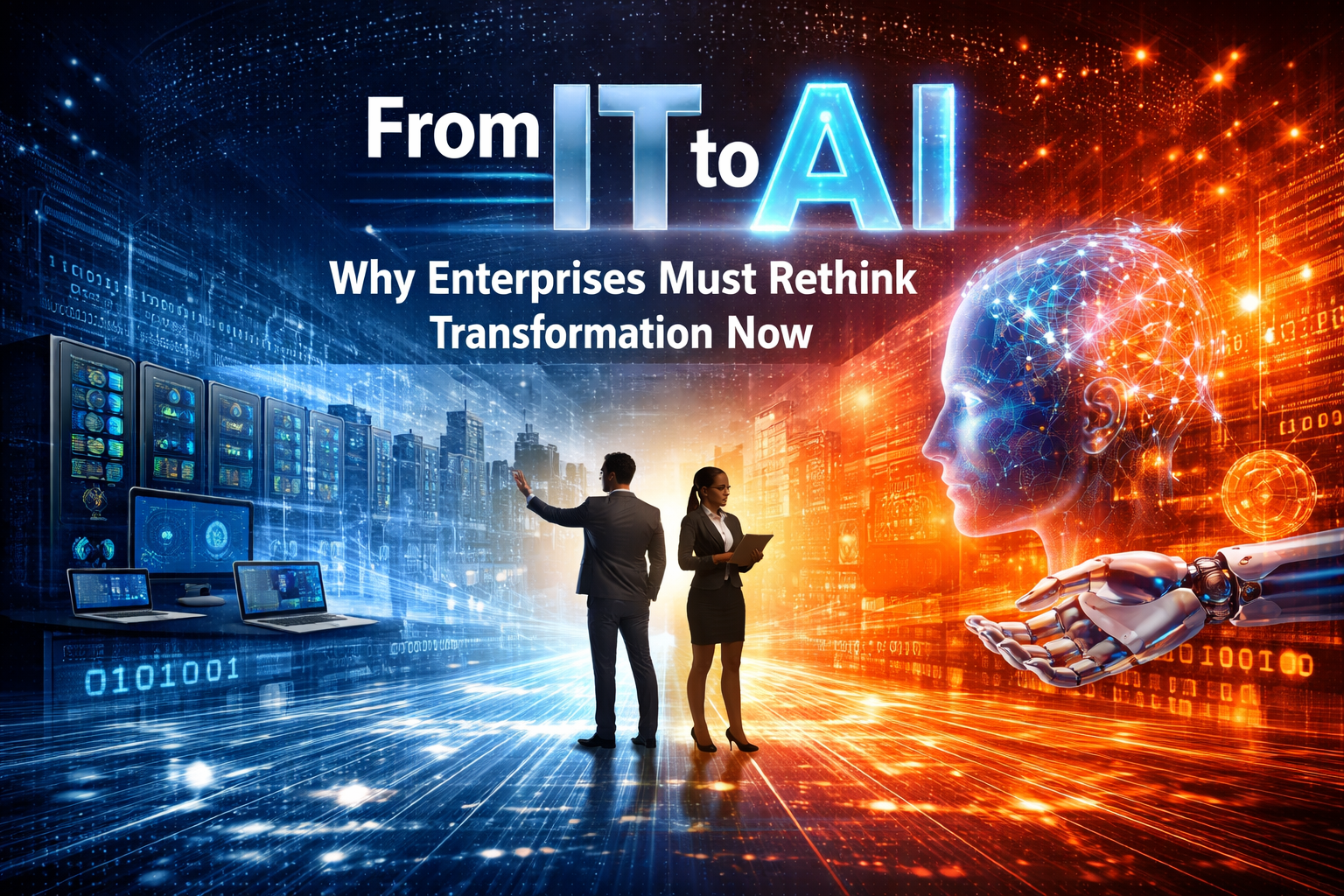
This is where the shift from IT to AI begins.
👉 https://www.conglomerateit.com/ITtoAi
The Rise of the AI-First Enterprise
We are entering a new era where systems don’t just store and process data—they:
- Interpret
- Decide
- Act
This marks the rise of the AI-first enterprise.
The Shift from IT to AI Is Not Evolution—It’s Replacement
Most organizations assume AI is an extension of IT.
It isn’t.
AI doesn’t enhance IT—it redefines how value is created.
Traditional IT Models
- Systems of record
- Static workflows
- Human-led decisions
AI-First Models
- Systems of intelligence
- Dynamic, self-learning workflows
- Autonomous decision-making
This is not incremental change. It’s a paradigm shift.
The Hidden Risk: Intelligence Debt
The biggest risk today isn’t disruption.
It’s delay.
What is Intelligence Debt?
The compounding cost of operating without AI while competitors continuously improve with it.
What It Impacts
- Decision-making speed
- Innovation cycles
- Revenue growth
Real-World Gap
- Competitors optimize pricing in real time
- You rely on weekly reports
- Competitors personalize at scale
- You segment broadly
Over time, the gap becomes exponential—and eventually unrecoverable.
Why Enterprises Must Act Now
1. AI Adoption Is Accelerating
AI is being embedded across operations—from customer service to supply chains.
2. The Cost of Delay Is Exponential
Every quarter without AI increases your intelligence debt.
3. Talent Is Moving Faster Than Organizations
AI-native professionals prefer innovation over maintaining legacy systems.
4. Competitive Advantage Is Being Rewritten
Leaders are defined by speed of intelligence, not scale.
AI Maturity Model: From IT Dependency to AI Autonomy
Stage 1: Ad-Hoc
- Individual AI usage
- No governance
Stage 2: Experimentation
- Isolated pilots
- Limited ROI
Stage 3: Strategic
- Unified data foundation
- AI supports decisions
Stage 4: AI-First Enterprise
- AI drives execution
- Systems self-optimize
Stage 5: AI-Native Organization
- AI defines business models
- Real-time adaptation
The Architecture Shift: Systems of Record → Systems of Intelligence
Legacy IT
- Siloed systems
- Batch processing
- Static dashboards
AI-First Architecture
- Unified data fabric
- Real-time pipelines
- Intelligent interfaces
Enterprise AI Architecture Stack
1. Data Layer
- Data lakehouse
- Real-time ingestion
- API-driven access
2. Model Layer
- LLMs
- Fine-tuned models
- Embeddings
3. Orchestration Layer
- AI agents
- Workflow automation
- Decision engines
4. Application Layer
- Copilots
- Chat interfaces
- AI-powered apps
5. Governance Layer
- Security
- Compliance
- Monitoring
From Automation to Agentic AI
Traditional Automation
If X → Then Y
Agentic AI Systems
- Understand context
- Adapt in real time
- Execute autonomously
This is not automation.
This is autonomous intelligence.
Generative AI: The Inflection Point
👉 https://www.conglomerateit.com/GenAi
Generative AI has:
- Democratized intelligence
- Enabled natural language interaction
- Reduced technical barriers
RAG: From Guessing to Knowing
Retrieval-Augmented Generation (RAG)
- Connects AI to enterprise data
- Eliminates hallucinations
- Ensures accurate outputs
Transforms AI into a reliable enterprise system
Natural Language Is Replacing Interfaces
In AI-first enterprises:
- Employees ask instead of search
- Systems respond instead of display
- Insights replace dashboards
Impact
- Increased productivity
- Faster execution
- Better accessibility
AI Governance: The Foundation of Trust
Key Pillars
- Private AI Environments → Secure data
- Explainability (XAI) → Transparent decisions
- Compliance → Regulatory alignment
Trust is essential for scaling AI
The Workforce Shift: IT Roles → AI-Native Roles
👉 https://www.conglomerateit.com/AINativeRoles
Emerging Roles
- Gen AI Architect
- AI Translator
- AI Orchestrator
- Data Pedigree Specialist
Industry Impact: AI Is Already Delivering Results
Manufacturing
- 30% reduction in downtime
Financial Services
- 80% improvement in fraud detection
Retail
- 20–25% increase in conversions
AI is operational—not experimental
Why Most AI Transformations Fail
Common reasons:
- Treating AI as an IT project
- Poor data readiness
- Lack of ROI clarity
- Talent gaps
- Weak governance
Biggest mistake:
Trying to fit AI into IT instead of replacing IT thinking
Build vs Buy vs Partner
Build
- Full control
- Slow & expensive
Buy
- Fast
- Limited differentiation
Partner (Best Approach)
- Faster execution
- Lower risk
- Expert access
Implementation Roadmap: IT to AI
Step 1: Define business outcomes
Step 2: Build data foundation
Step 3: Launch RAG use case
Step 4: Scale across functions
Step 5: Drive cultural change
The Cost of Inaction
Delaying AI adoption leads to:
- Slower growth
- Higher costs
- Competitive loss
- Talent attrition
The divide is already here.
Why ConglomerateIT
At ConglomerateIT, AI is not a tool—it’s a transformation layer.
We help enterprises:
- Transition from IT to AI
- Build scalable architectures
- Deploy AI-native talent
- Achieve measurable outcomes